Parts, serial numbers and lead times on a built-in
That a model name is enough to order a part, and that every repair either happens on the first visit or does not happen at all.
Monday to Friday 8:00am – 6:00pm · Saturday 9:00am – 4:00pm
(904) 478-8963The column runs but is not cooling: the cabinet drifts warm, or one section cools while the other does not
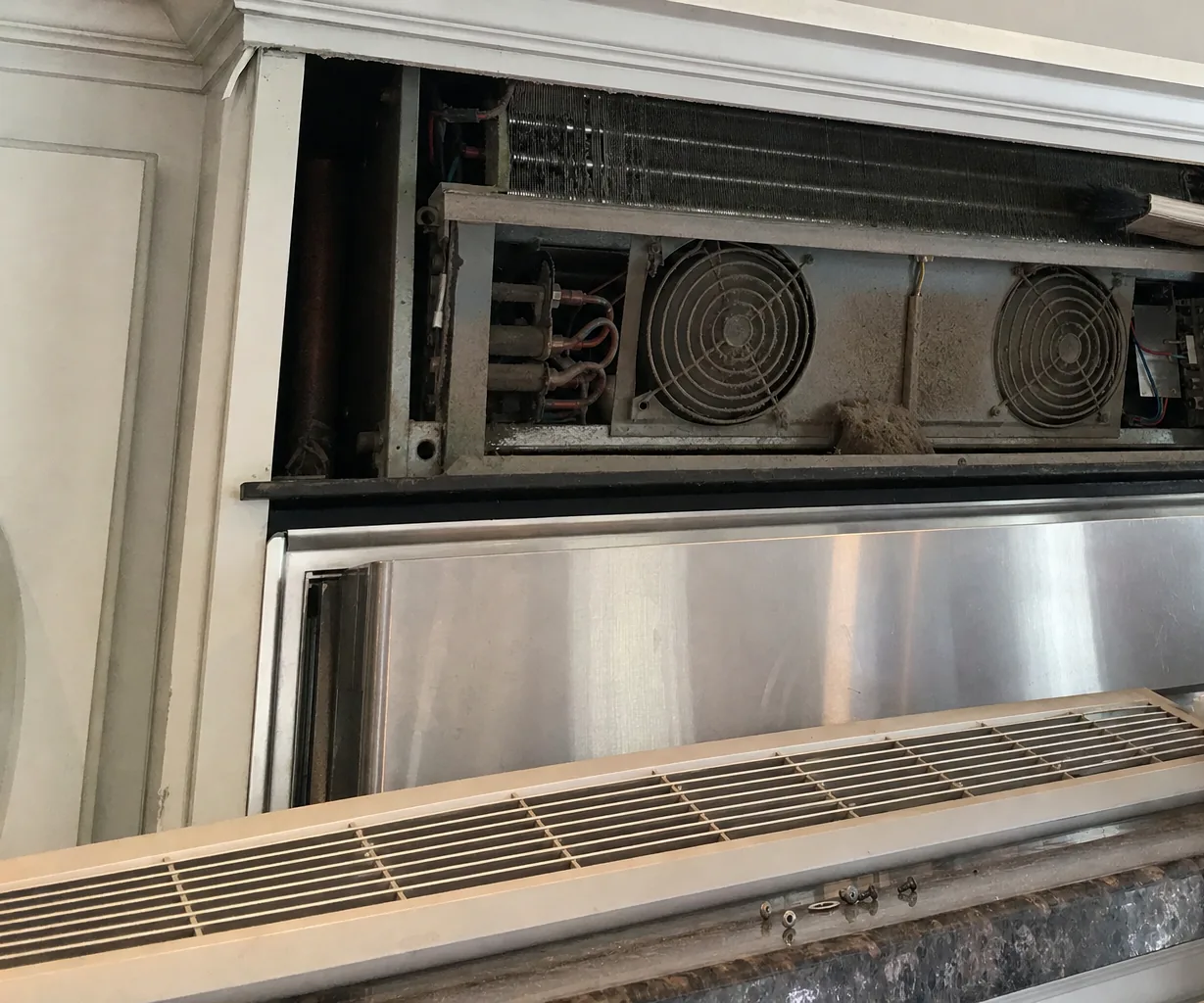
Causes are listed as symptoms and mechanisms, not part numbers. The actual fault is confirmed on site.
40°F is the line
Above it, move food. Refrigeration is the one fault on this site that will not wait.
“Not cooling” on a built-in column almost never means the cabinet is at room temperature. It means it has drifted, and on refrigeration a slow drift matters more than a dramatic failure. A column sitting at 48°F looks and sounds completely normal. It is still spoiling food. Put a thermometer in a glass of water on the middle shelf, leave it four hours, and read that instead of trusting the display.
If the reading is above 40°F, move perishables now and book. Everything below that is a scheduled appointment.
A refrigeration column rejects heat through a condenser fed by a narrow air path, usually at the toe grille and out through the top of the cabinet. That path collects dust, pet hair and, in kitchens near Doctors Lake where the doors stay open in spring, a surprising amount of pollen. A condenser that cannot breathe makes a compressor that runs continuously and a cabinet that never quite gets cold.
Pull the toe grille and look. If the coil face is furred over, that alone can explain a five to eight degree drift, and clearing it is maintenance rather than repair. Check also that the cabinet above the unit has not been sealed off by a later kitchen renovation — this happens in Pace Island and older Fleming Island homes where the surround was rebuilt around an existing appliance.
If the condenser is clear and the compressor is running, the next question is whether cold air is being made and whether it is being moved. Those fail separately.
An evaporator that has iced over produces exactly the complaint people describe as “it runs all the time and it is barely cool”. The refrigerant is doing its job; the ice is insulating the coil and blocking the air path across it. That comes from a defrost heater, sensor or control that has stopped completing its cycle. The tell is a fridge that improves for a day after being emptied and switched off, then falls back over the following week.
An evaporator fan that has stopped gives a different picture: one compartment gets very cold while another warms up, because the air is not being distributed. On a column pairing refrigeration with freezing, that split is the clearest diagnostic clue available without tools.
A door that no longer pulls square lets humid room air in continuously. In Northeast Florida that means ice buildup as well as a warm cabinet, because the system is trying to cool the room. Run a note of paper around the gasket with the door closed — anywhere it slides out with no resistance is a leak path.
Retrofitted installations deserve extra attention. When a column has been fitted into an opening built for an older appliance, the door can appear closed while the hinge geometry keeps it from sealing at the top. That is an installation fault, not a component failure, and it will not be fixed by replacing parts.
Only after all of the above does the sealed refrigerant circuit come into question. This is where EPA Section 608 certification matters — it is a federal technician credential covering refrigerant handling, and it is genuinely held here. It is not a manufacturer program and nothing on this site claims otherwise.
A sealed-system diagnosis is made by reading how the system behaves over time, not by guessing from the symptom. It is also the most expensive outcome, which is exactly why the cheap causes above get eliminated first.
Ice production is a separate system with its own supply, its own valve and its own temperature dependency, so treat it as a separate fault. Ice that is hollow, small or has stopped entirely while the cabinet itself holds temperature points at the fill valve, the supply line or the ice maker’s own control rather than at anything described above.
The direction of the evidence matters. A freezer compartment that has drifted warm will also stop making good ice, so ice quality is a useful early symptom of a cabinet fault — but a cabinet at temperature with bad ice is an ice maker fault, and those two want different visits.
Flat $80 diagnostic, credited toward the repair, written estimate before any work begins, genuine OEM parts, 90 days on labor and 365 days on parts. Scheduled appointments Monday to Friday and Saturday mornings across Clay County.
$80 covers the diagnosis, and it is taken off the total if you decide to go ahead. Past that the figure is set by which component has actually failed, and the rows below are where a refrigeration column repair has been settling. Nobody here quotes one number before the panel is off.
| What has failed | Parts and labor |
|---|---|
| Diagnostic visit | $80 flat |
| Refrigeration column sealed system | $920–$2,400 |
| Control board or touch panel | $440–$1,010 |
Ranges, not quotes. The width of a band is mostly access: a component reached from the front is one job, and the same component behind an appliance that has to come out of its opening is quite another. How a job is priced.
That a model name is enough to order a part, and that every repair either happens on the first visit or does not happen at all.
That a repair is priced by the size or the age of the appliance, rather than by which single component inside it has actually failed.
That an appliance failing the week after a storm is a coincidence, and that surviving the outage without visible damage means the electronics are fine.
That appliance maintenance is mostly about cleaning cycles and additives, rather than about airflow, filtration and seals.
That a replacement built-in drops straight into the opening the old appliance came out of, and that a fit problem is only cosmetic.
That an ice maker which has stopped is an ice maker fault, when it is far more often the water reaching it or the temperature around it.
That there is nothing useful an owner can do before a service visit except wait, and that a code on the display is the whole story.
That calling an independent technician or fitting a non-Thermador part cancels the warranty, when Thermador's own range statement says neither one voids it.
That a built-in appliance can be judged by the same replace-it-cheaply arithmetic as a freestanding machine.
Rated 4.5 out of 5 across 72 customer reviews. Read all 72.
The unit ran constantly and never quite got cold. He pulled the grille and the condenser was matted with construction dust from the extension. Cleaned it, rechecked the draw, and it cycles properly now.
Terrell G.June 2026
Our column crept to the high forties while the freezer alongside stayed cold. He measured airflow at the vent, found the evaporator fan stalling once warm, and had it changed before he left the house.
Charmaine B.August 2026
Ice was building up behind the rear panel and the cabinet drifted warm between defrosts. He tested the heater and its limit, found the limit had gone open circuit, and fitted a new one. Steady ever since.
Josephine W.July 2026
Flat $80 diagnostic, credited toward the repair. Written estimate before any work begins. Serving Clay County.
Call (904) 478-8963