Thermador wall oven not heating or running cool
The oven is not heating up: it preheats slowly, runs cool, or never reaches the set temperature
Monday to Friday 8:00am – 6:00pm · Saturday 9:00am – 4:00pm
(904) 478-8963Corrects That a replacement built-in drops straight into the opening the old appliance came out of, and that a fit problem is only cosmetic.
Joinery, not components
A door held out of square by a cabinet will never seal, whatever parts you replace.
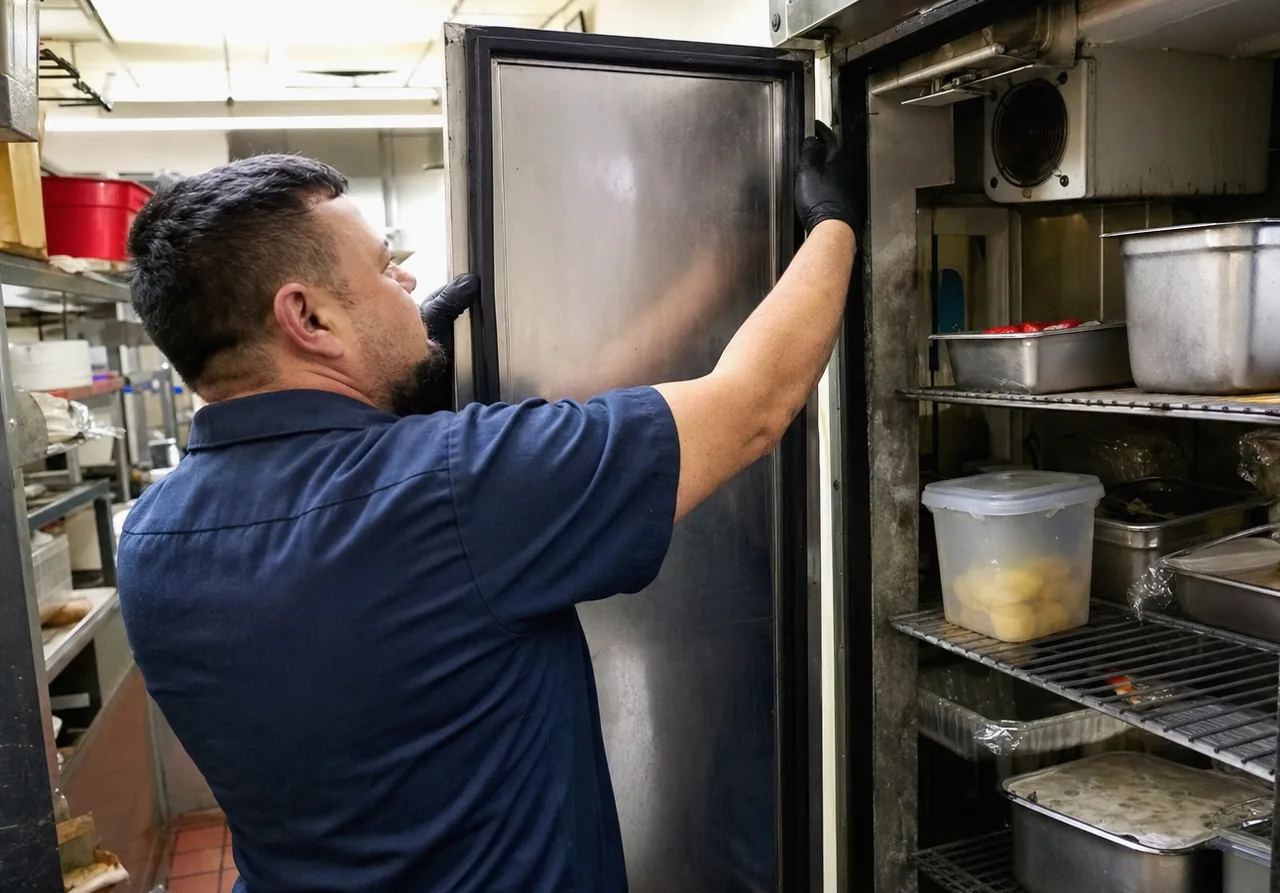
A large share of what looks like appliance failure in older Clay County kitchens is installation geometry. The appliance is healthy. It is being held in a position it cannot work in. No amount of component replacement addresses that, which is why these faults come back after a repair and why it is worth recognising them before you spend money.
Built-in dimensions have moved. Refrigeration columns are deeper and taller than the built-in refrigerators they typically replace. Wall oven cutout heights have grown. Cooktop cutouts have changed both in size and in the shape of the corner radii. Dishwasher tub heights have crept up as insulation packages thickened.
None of this is a problem in a kitchen designed around current appliances. It is a considerable problem in a kitchen from the 1980s or 1990s — Pace Island, the older Fleming Island streets, the established parts of Orange Park — where the cabinetry was built around whatever was on the showroom floor at the time and has not moved since.
The failure mode is nearly always the same: the appliance goes in, the door looks closed, and the door is not sealing.
A column that is even slightly pinched by its cabinet sides has its door geometry decided by the joinery rather than by its hinges. The gasket contacts along part of its run and not along the rest. You cannot see the gap. You can find it by closing the door on a strip of paper and pulling — anywhere it slides out freely is a leak path.
What follows is a compressor running continuously, a cabinet that never settles, and often ice on the evaporator because humid room air is being drawn in constantly. In this climate that second effect arrives fast. The complaint that gets phoned in is “it runs all the time and it is barely cold”, and the cause is a cabinet three millimetres too narrow.
The second refrigeration issue is heat rejection. These units breathe in at the toe grille and out through the top of the cabinet. A remodel that closed off the space above the appliance, or a flush decorative panel fitted with no gap, removes the exit path. The appliance then rejects its heat into a sealed box and loses.
Two things go wrong. If the cutout is fractionally short, the trim is used to close the gap and the appliance body ends up under load, which distorts the door frame and stops the door pulling square. The cavity vents continuously, the oven reads cool, and the control panel above runs hot.
The other is ventilation. Wall ovens rely on defined clearances above, below and behind, and a cabinet packed tight around the body traps heat against the electronics. Boards that live hot fail early. If a replacement oven has failed twice in the same opening, stop replacing boards and measure the cabinet.
A hood installed under an existing soffit inherits whatever duct is already up there. That is commonly flexible rather than rigid, frequently reduced in diameter to clear a joist bay, and often carrying more bends than the run length would suggest.
Flexible duct has several times the resistance of smooth rigid pipe at the same diameter, and each reduction and each bend adds more. A blower rated for a straight rigid run will move a fraction of that through a throttled one. The hood is loud, the kitchen still fills with steam, and the appliance is not at fault.
Three recurring faults, all created at installation. A drain hose without a high loop rising to the underside of the counter lets sink water siphon back into the tub. A disposer fitted by a different trade with the knockout plug still in place stops the dishwasher draining at all. A water line run with a kink behind the machine restricts fill and produces poor washing that reads as a spray arm problem.
All three are found under the sink in five minutes and none of them require a part.
A stacked column — steam oven, coffee system, warming drawer — asks for more dedicated circuit capacity than most older kitchens were wired for. The symptom is not a dead appliance. It is nuisance breaker trips when two of them run at once, which owners tend to blame on whichever appliance was last switched on.
If your appliance has been replaced recently, or the kitchen has been renovated around an appliance, say so when you book. It is as useful as the storm-week question. A visit that starts by measuring the opening and checking the seal is a much better use of a $80 diagnostic than one that starts by ordering a part.
$80 covers the diagnosis, and it is taken off the total if you decide to go ahead. Past that the figure is set by which component has actually failed, and the rows below are where the work this page describes has been settling. Nobody here quotes one number before the panel is off.
| What has failed | Parts and labor |
|---|---|
| Diagnostic visit | $80 flat |
| Igniter, spark module or surface element | $210–$490 |
| Oven thermostat or temperature sensor | $180–$560 |
| Bake or broil element | $210–$580 |
| Convection fan or motor | $260–$670 |
| Control board or touch panel | $440–$1,010 |
| Door hinge, glass or seal | $180–$680 |
| Refrigeration column sealed system | $920–$2,400 |
Ranges, not quotes. The width of a band is mostly access: a component reached from the front is one job, and the same component behind an appliance that has to come out of its opening is quite another. How a job is priced.
The oven is not heating up: it preheats slowly, runs cool, or never reaches the set temperature
A zone beeps, flashes and shuts off, or will not detect the pan at all
The column runs but is not cooling: the cabinet drifts warm, or one section cools while the other does not
The dishwasher is not draining: water is standing in the bottom of the tub at the end of the cycle
The igniter clicks continuously but the burner will not light, or lights then goes out
The blower runs at full speed but smoke and steam still spill into the room
A diagnostic beats a guess. Scheduled appointments across Clay County.
Call (904) 478-8963