Thermador steam oven not making steam
The oven heats but never produces steam, or the cycle stops early
Monday to Friday 8:00am – 6:00pm · Saturday 9:00am – 4:00pm
(904) 478-8963Corrects That a built-in appliance can be judged by the same replace-it-cheaply arithmetic as a freestanding machine.
The cabinet is in the price
Replacing a built-in is rarely just an appliance. That is what changes the arithmetic.
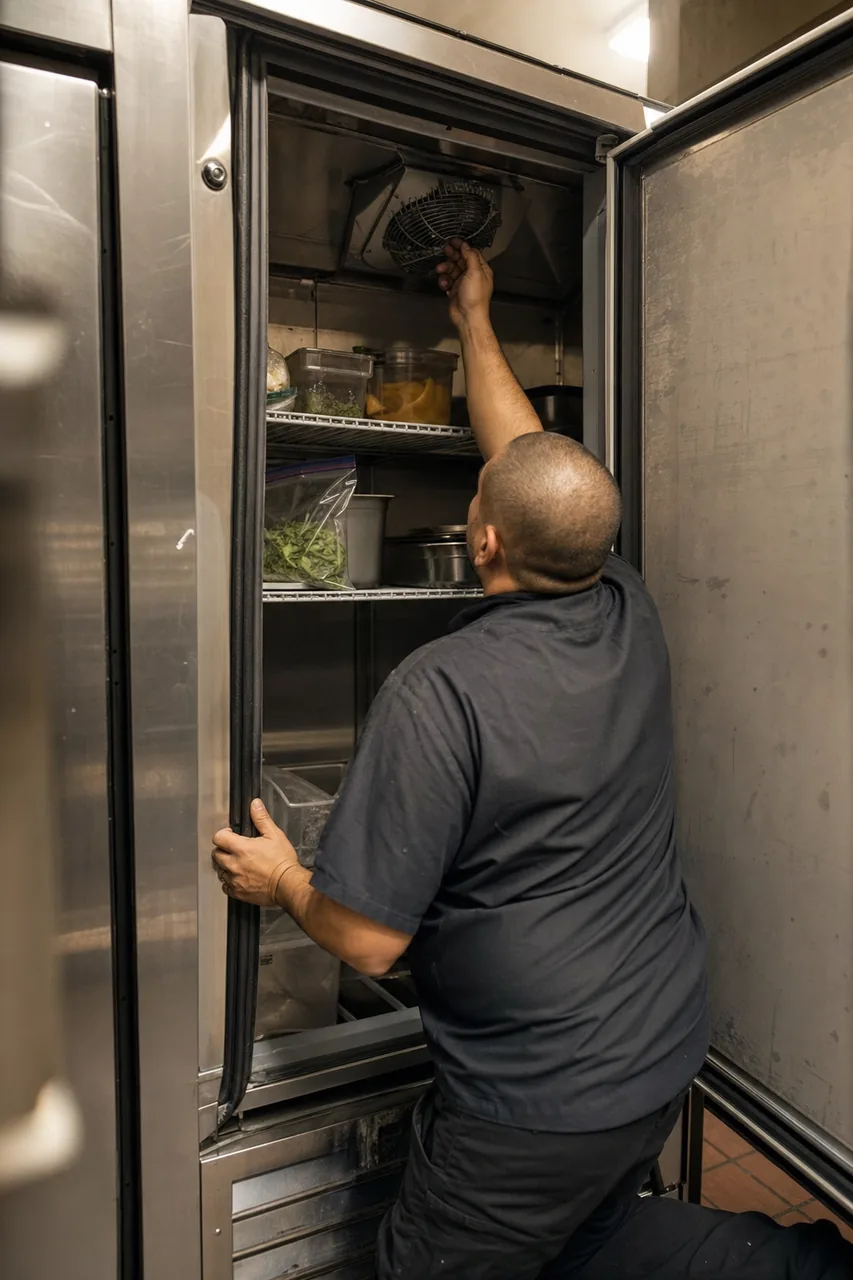
The advice people bring to a built-in appliance is usually borrowed from a freestanding one: if the repair costs more than half of a new machine, replace it. That rule does not survive contact with equipment that is fitted to the cabinetry, panelled to match the joinery and sized to an opening that no longer exists in current dimensions.
A built-in is part of the kitchen. Swapping one is an appliance purchase plus, frequently, a joinery job: cutout heights have grown, columns are deeper and taller than what they replace, cooktop cutouts have changed shape, and a custom panel made for the old door does not transfer.
Add the practical work — pulling a heavy column out over a finished floor, releasing an anti-tip fixing, checking a dedicated circuit is where the new appliance needs it, confirming the duct behind a hood is adequate for what is being installed — and a like-for-like replacement is rarely like-for-like. None of that argues against replacing. It argues against comparing a repair to the sticker price alone.
Against that, most faults on this equipment are one component. A fan motor, a thermal fuse, a hinge set, a gasket, a valve, a pump, a board: each is a fraction of a replacement, and fitting one restores an appliance that is already sized, panelled and wired into the kitchen it lives in.
The parts that decide the answer are the expensive ones. A full control assembly, a compressor or another sealed-system component, or a door in a custom finish sits in a different band, and that is the point where the arithmetic becomes a real decision rather than an obvious one.
Four, in order.
Is the fault the appliance at all? A door held out of square by a cabinet three millimetres too narrow, a hood strangled by flexible duct, a dishwasher that will not drain because a disposer knockout plug was never removed — none of those are appliance failures, and replacing the machine reproduces the fault in a new box. This is the first question because getting it wrong is the most expensive mistake available.
Is the part in current supply? A current component with a confirmed diagnosis is a straightforward repair. A superseded part with no supply is not a repair at any price, and the estimate should say so plainly.
How much of the appliance has already been replaced? One board on an otherwise sound machine is good value. A third major component on the same appliance in two years is a pattern, and the pattern usually points at heat, supply or geometry rather than bad luck — worth diagnosing before spending again.
What does the rest of the kitchen want to do? If the cabinetry is due to be reworked anyway, a repair that buys two more seasons may be exactly the right purchase. If the kitchen is staying as it is, keeping the appliance that fits it is usually cheaper than starting a chain of changes.
The rule most people arrive with says replace once a repair passes half the price of a new appliance. On a freestanding machine that is a fair shortcut. On a built-in it quietly takes the side of replacement, because the replacement figure in the second table below is the appliance and nothing else.
Delivery, installation, an altered cutout, a panel made for the old door, and the work of getting a heavy column out over a finished floor and a new one back in are all real and all on top of it. None of them are in the rule. Run the rule against what replacement actually costs a household rather than against a sticker price, and the line it draws moves a long way toward repair.
The two tables below are the whole of the arithmetic: what a repair costs according to which component failed, and what the equivalent new appliance costs before anybody delivers it. Set one against the other and almost every decision lands in one of three places.
Clearly worth repairing. One component has failed on an appliance that is otherwise sound — an element, a temperature sensor, a fan motor, a hinge set, a valve, a pump. Each of those sits in the lower half of the repair table against a replacement figure that runs to four and sometimes five digits for the appliance alone. That is not a close call, and treating it as one would be selling a kitchen rather than a repair.
A judgement call. The dearest rows — a sealed system on a refrigeration column, or a full control assembly — on an appliance that has already had one or two major components through it. The question here is no longer what this repair costs. It is whether this is the last one, and that is answered by what has already been replaced, by whether the kitchen is running the appliance hot, tight or on a shared circuit, and by how long the remaining parts are likely to stay in supply.
Age on its own does not decide this. A twenty-year-old built-in whose parts are still current and whose failures have been ordinary wear is a better prospect than a much younger appliance whose control assembly has been superseded. Ask about supply before you ask about the year.
Not worth it. A superseded part with no supply is not a repair at any price, whatever the labour would have been. Neither is a fault that is really the installation: a cutout three millimetres too narrow, a duct that was never adequate, a circuit shared with something it should not be. Replacing the appliance reproduces every one of those in a new box, and the estimate should say so in writing before anyone spends.
An independent repair company is not the right first call for everything.
If the appliance is inside its manufacturer warranty, use it — an independent repair can complicate a warranty claim, and nothing on this site is worth that. If there is an open recall or a service action for the model, that is the manufacturer’s to carry out. If the fault is a documented safety action rather than a wear failure, the same applies.
Saying that costs a job and keeps the advice trustworthy, which is the only thing a site like this has to sell.
The flat diagnostic exists to answer the repair-or-replace question with a fault, not an impression. It ends in a written estimate that names the part, the labour and the expected wait, and it is credited toward the repair if you go ahead. If the answer is that the appliance is not worth repairing, you have that in writing too, and you can spend the money once instead of twice.
$80 covers the diagnosis, and it is taken off the total if you decide to go ahead. Past that the figure is set by which component has actually failed, and the rows below are where the work this page describes has been settling. Nobody here quotes one number before the panel is off.
| What has failed | Parts and labor |
|---|---|
| Diagnostic visit | $80 flat |
| Igniter, spark module or surface element | $210–$490 |
| Oven thermostat or temperature sensor | $180–$560 |
| Bake or broil element | $210–$580 |
| Convection fan or motor | $260–$670 |
| Control board or touch panel | $440–$1,010 |
| Door hinge, glass or seal | $180–$680 |
| Refrigeration column sealed system | $920–$2,400 |
A comparable Thermador wall oven, rangetop or column, appliance only — before delivery, installation or cabinetry. National appliance pricing, not Florida labour.
| New appliance | Appliance only |
|---|---|
| Wall oven, the usual repair-or-replace comparison | $4,200–$9,500 |
| Professional rangetop or range | $5,500–$14,500 |
Ranges, not quotes. The width of a band is mostly access: a component reached from the front is one job, and the same component behind an appliance that has to come out of its opening is quite another. How a job is priced.
The oven heats but never produces steam, or the cycle stops early
The oven is not heating up: it preheats slowly, runs cool, or never reaches the set temperature
The column runs but is not cooling: the cabinet drifts warm, or one section cools while the other does not
The dishwasher is not draining: water is standing in the bottom of the tub at the end of the cycle
The machine reports no water, or grinds and heats but never brews
A diagnostic beats a guess. Scheduled appointments across Clay County.
Call (904) 478-8963