Thermador steam oven not making steam
The oven heats but never produces steam, or the cycle stops early
Monday to Friday 8:00am – 6:00pm · Saturday 9:00am – 4:00pm
(904) 478-8963Corrects That appliance maintenance is mostly about cleaning cycles and additives, rather than about airflow, filtration and seals.
Five jobs, twice a year
Airflow, filters and seals decide how long a built-in lasts. Almost nothing else does.
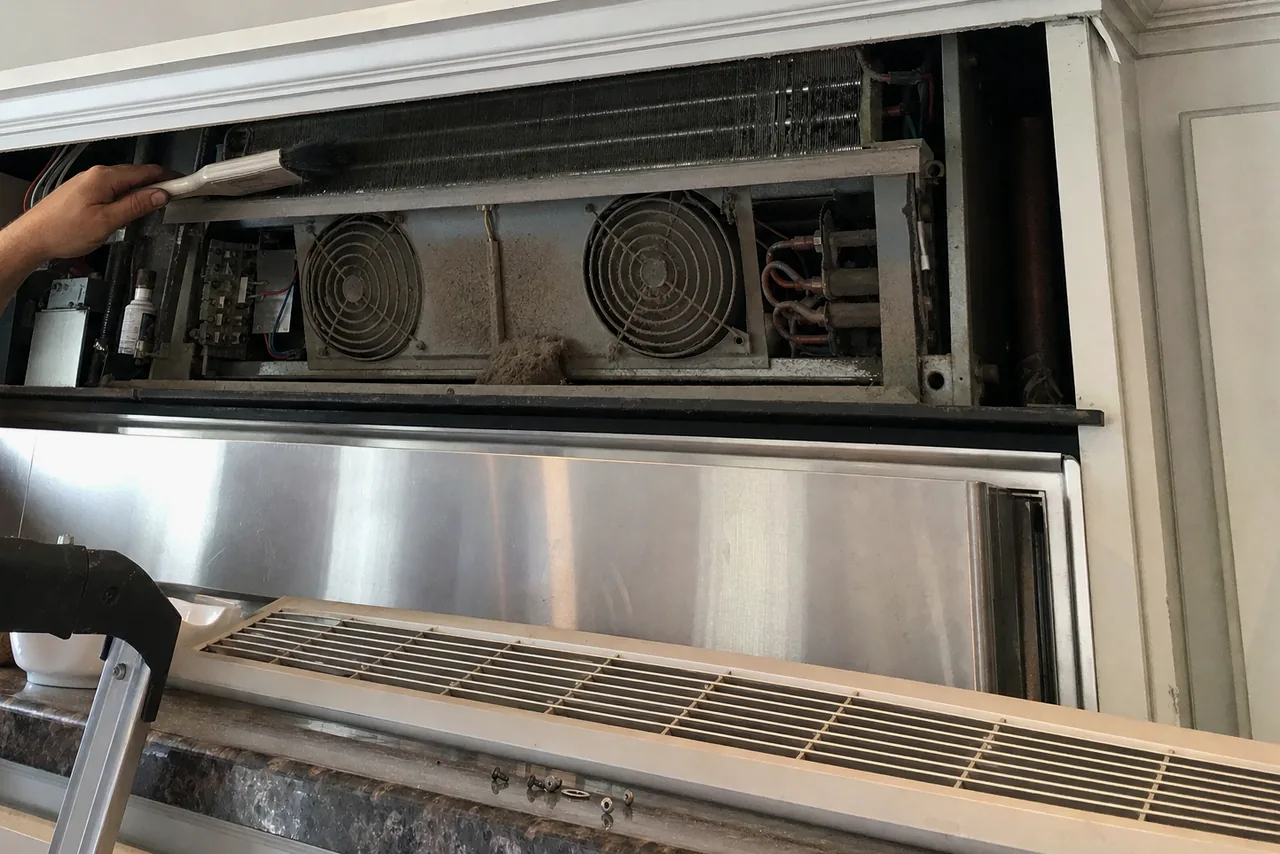
Most owner maintenance advice is written for the wrong end of the machine. What actually shortens the life of a built-in appliance is restricted airflow, loaded filtration and a seal that no longer seals — and all three are visible, cheap and reversible if anyone looks. Here is the whole list, in order of how much trouble each one prevents.
Built-in refrigeration rejects heat through a narrow path: in at the toe grille, across the condenser, and out through the top of the cabinet. That coil face collects dust, pet hair and pollen, and a furred coil raises condensing temperature, lengthens run time and can account for several degrees of cabinet drift on its own.
Pull the toe grille, look with a torch, and clear the face with a soft brush and a vacuum. Then check the exit above the cabinet is not blocked by a panel or a remodel. Ten minutes, twice a year, and it prevents more warm-cabinet calls than any other single job.
Twist out the filter cylinder, lift the flat screen beneath it, and wash both in hot water with a brush. Grease sets into that mesh as a film long before you can see anything, and a half-blocked filter drops wash pressure, slows drainage and recirculates soil.
While the filter is out, look into the sump for glass, a seed or a label — the three things that stop a drain pump — and check that the spray arm holes are clear and the arm spins freely by hand.
A gasket does not fail visibly. Close the door on a strip of paper and pull it out, at four or five points around the door. Where it slides free, the seal is doing nothing there.
On refrigeration that leak admits humid room air, which shows up as evaporator ice and a cabinet that never settles. On a wall oven or a steam oven it vents the cavity, so the appliance reads cool, preheats slowly and runs its control panel hot. Relaxed hinge springs produce the same symptom as a compressed gasket and need the same test to tell them apart.
Baffle and mesh filters are meant to be washed, not replaced when they look dark. Once the mesh is loaded, the free area collapses and the blower spends its energy on noise instead of air. Wash them on their own in the dishwasher, or by hand in hot water with detergent.
Behind them, look at the blower wheel with a torch. Grease builds on the blades as a thick, even coating that both adds weight and destroys the blade profile, and that is the classic cause of a hood that got gradually quieter in effect and louder in sound over several years. A recirculating hood also has a charcoal filter, which is consumable and frequently has never been changed at all.
Cartridge filters in refrigeration and in built-in coffee systems have a time life as well as a volume life. Past it, the medium swells, flow falls away, and the machine reports weak pressure, short shots or no water at all. Change on the date, not on the appearance.
A removable brew unit should come out, rinse under warm water with no detergent, drain and go back without force. Compacted grounds behind it will physically stop it completing its travel, and a unit that cannot reach its home position will refuse to admit water.
Additives and cleaning cycles poured in as a precaution do very little. A descale cycle is maintenance the appliance asks for when it has counted enough water through itself — run it then, and do not add extra cycles out of anxiety, and never run one as a diagnostic on an appliance that has already stopped. If the pump is not moving water, a descale circulates nothing for two hours and teaches you nothing.
Nor does more detergent. Overdosing leaves film on glassware and residue on the tub floor, and enough foam to slow drainage. If the glasses look cloudy, the first experiment is less detergent, not another product.
Whole-house surge protection at the panel. It is an electrician’s job, it costs less than one control board for a built-in, and in a county that averages around 68 thunderstorm days a year it addresses the leading cause of failure in this equipment rather than a background one.
$80 covers the diagnosis, and it is taken off the total if you decide to go ahead. Past that the figure is set by which component has actually failed, and the rows below are where the work this page describes has been settling. Nobody here quotes one number before the panel is off.
| What has failed | Parts and labor |
|---|---|
| Diagnostic visit | $80 flat |
| Igniter, spark module or surface element | $210–$490 |
| Oven thermostat or temperature sensor | $180–$560 |
| Bake or broil element | $210–$580 |
| Convection fan or motor | $260–$670 |
| Control board or touch panel | $440–$1,010 |
| Door hinge, glass or seal | $180–$680 |
| Refrigeration column sealed system | $920–$2,400 |
Ranges, not quotes. The width of a band is mostly access: a component reached from the front is one job, and the same component behind an appliance that has to come out of its opening is quite another. How a job is priced.
The oven heats but never produces steam, or the cycle stops early
The column runs but is not cooling: the cabinet drifts warm, or one section cools while the other does not
The dishwasher is not draining: water is standing in the bottom of the tub at the end of the cycle
The machine reports no water, or grinds and heats but never brews
The blower runs at full speed but smoke and steam still spill into the room
A diagnostic beats a guess. Scheduled appointments across Clay County.
Call (904) 478-8963