The parts that decide the price
That a repair is priced by the size or the age of the appliance, rather than by which single component inside it has actually failed.
Monday to Friday 8:00am – 6:00pm · Saturday 9:00am – 4:00pm
(904) 478-8963A zone beeps, flashes and shuts off, or will not detect the pan at all
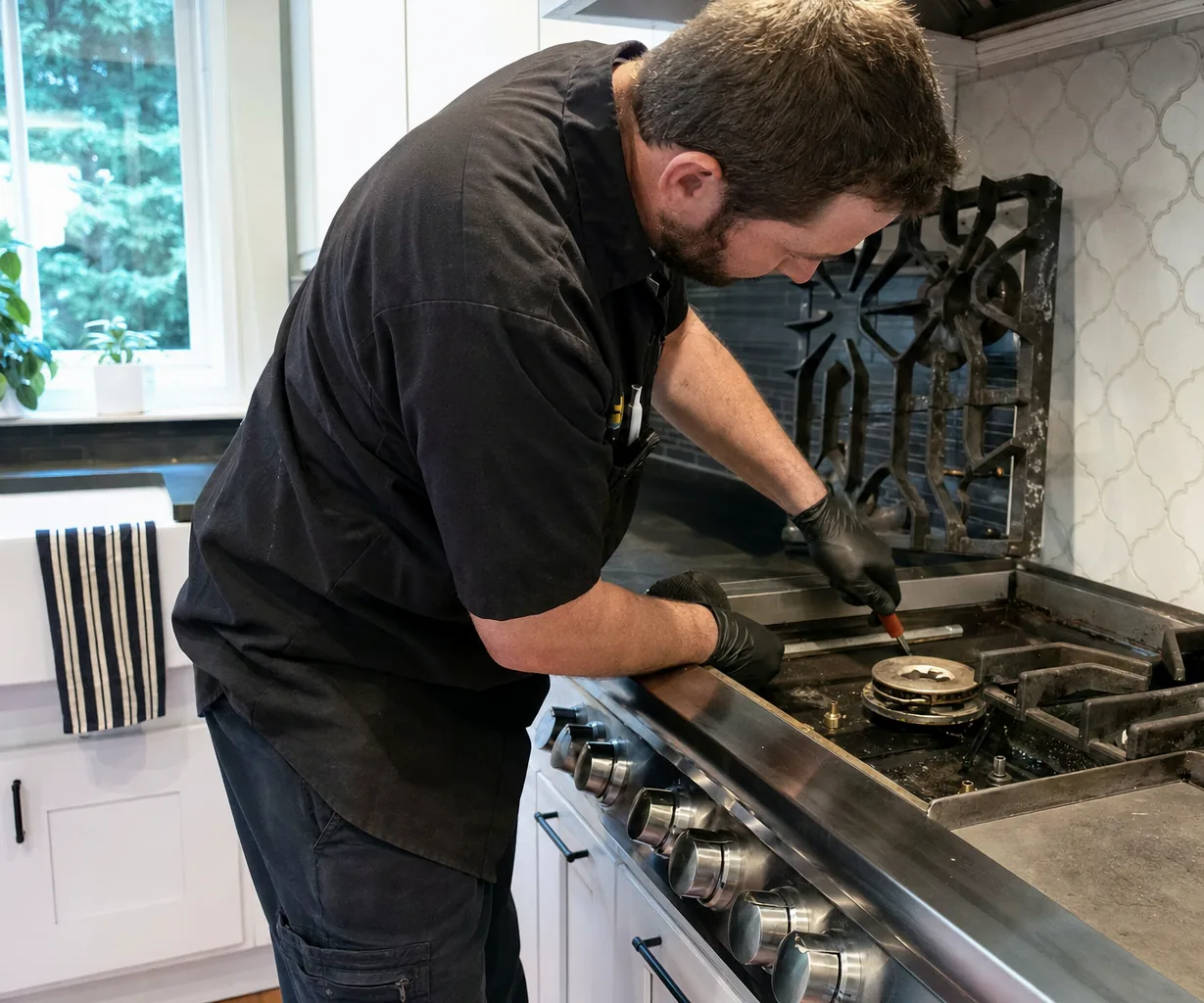
Causes are listed as symptoms and mechanisms, not part numbers. The actual fault is confirmed on site.
Half of these are the pan
Test every zone with one known-good magnetic pan before booking anything.
An induction cooktop that beeps and drops a zone is the one fault on this site you have a real chance of solving yourself in ten minutes. It is also the fault most often misread as a dead appliance, because the symptom looks dramatic and the cause is frequently sitting in the cupboard.
Take a single pan you know works — a heavy magnetic one, base flat, at least as wide as the ring painted on the glass — and run every zone with it in turn. Give each zone a minute at a medium setting.
If that pan works everywhere, the cooktop is fine and your other cookware is the problem. If it fails on one zone and works on the rest, the fault is in that zone’s coil, sensing or power module. If it fails everywhere, look at the supply and the control before anything else. Those three outcomes point in three completely different directions, and the test costs nothing.
A refrigerator magnet stuck firmly to the base of a pan means it will heat. A magnet that clings weakly means the pan will work intermittently, drop out when it gets hot, and drive you to conclude the appliance is faulty. Some tri-ply pans and most stainless pans with a thin magnetic disc behave exactly that way.
Induction depends on the pan sitting flat and covering enough of the coil. A base that has gone convex from years of heat — a slight dome you can see by laying a straight edge across it — lifts the centre off the glass and reduces coupling. So does a pan whose base is smaller than the zone marking, which is why a small saucepan on a large bridge zone often refuses to latch on.
Induction electronics live directly under the glass, and they are cooled by a fan drawing air through a vent. If that vent is blocked, or the fan is failing, the cooktop protects itself by shutting a zone down. The tell is timing: the appliance works from cold, runs for fifteen or twenty minutes, then drops zones one after another. Cooking that produces steady high heat brings it on fastest.
Check that nothing stored in the cabinet below is pressed against the vent path, and listen for the fan running during a long boil. A cooktop installed over a warming drawer or a tightly packed cabinet is more likely to run into this than one with clear air below it.
If the one-pan test fails on a single zone with good cookware and clear ventilation, the fault is under the glass — the sensing circuit that decides whether a pan is present, or the power module driving that coil. Modules on these cooktops commonly serve zones in pairs, which is why two adjacent zones sometimes fail together and the rest keep working. That pattern is useful information; note it before you call.
Losing one leg of the 240-volt supply produces a different picture again: the control panel lights and responds normally while no zone will heat at all. If the cooktop went quiet during a storm week, that is where to look first. This county averages around 68 thunderstorm days a year and momentary outages are routine.
Cleaner residue baked onto the glass is cosmetic. It is not thick enough to lift a pan out of coupling range and it does not interfere with the sensing circuit, so a cooktop that looks marked and works is simply a cooktop that looks marked.
Nor is the cookware’s brand or price relevant, only its base: enough ferrous content for a magnet to hold firmly, a flat contact face, and a diameter that suits the zone. A heavy expensive pan with a warped or largely non-magnetic base will drop out where a cheap flat steel one holds.
If the one-pan test says the appliance is at fault, the flat $80 diagnostic covers confirming which zone, which component and whether the supply is intact, with a written estimate before any work begins. The diagnostic is credited toward the repair. Parts are genuine OEM, with 90 days on labor and 365 days on parts. Stop using the cooktop and book straight away if the glass is cracked or chipped, or if a zone heats when nothing is set.
$80 covers the diagnosis, and it is taken off the total if you decide to go ahead. Past that the figure is set by which component has actually failed, and the rows below are where a cooktop repair has been settling. Nobody here quotes one number before the panel is off.
| What has failed | Parts and labor |
|---|---|
| Diagnostic visit | $80 flat |
| Control board or touch panel | $440–$1,010 |
Ranges, not quotes. The width of a band is mostly access: a component reached from the front is one job, and the same component behind an appliance that has to come out of its opening is quite another. How a job is priced.
That a repair is priced by the size or the age of the appliance, rather than by which single component inside it has actually failed.
That an appliance failing the week after a storm is a coincidence, and that surviving the outage without visible damage means the electronics are fine.
That a replacement built-in drops straight into the opening the old appliance came out of, and that a fit problem is only cosmetic.
That there is nothing useful an owner can do before a service visit except wait, and that a code on the display is the whole story.
That calling an independent technician or fitting a non-Thermador part cancels the warranty, when Thermador's own range statement says neither one voids it.
That a gas burner which glows or clicks without lighting always needs a new igniter, when a damp tip, a crooked cap or a tripped breaker gives the same symptom.
Rated 4.5 out of 5 across 72 customer reviews. Read all 72.
Our largest zone had stopped working while the rest were fine. He isolated the generator board feeding that half rather than replacing the whole control, which I gather is the usual approach. It has been solid since.
Ambrosine T.May 2026
The cooling fan under the cooktop was howling and zones were cutting out. He replaced the fan and the noise went, but a rattle came back a week later and he had to return to reseat a clip he had left loose.
Georgette P.June 2026
One zone would run for a minute then beep and quit. He put a straight edge across the pan base and showed me it had warped just enough to lose contact. A different pan and the zone behaved perfectly.
Drusilla M.August 2026
Flat $80 diagnostic, credited toward the repair. Written estimate before any work begins. Serving Clay County.
Call (904) 478-8963